

For everyday carry buyers who prioritize low weight and long-term corrosion resistance, titanium is the better lighter material. Choose stainless steel if you want a heavier, denser hand feel at a lower price. Titanium wins on strength-to-weight and finish versatility; stainless wins on stiffness, cost, and raw durability against dents. Both titanium and stainless steel lighters are available, suited to different carrying preferences.
TL;DR:
- Titanium is about 40 to 45% lighter than stainless steel at the same volume, making it ideal for low-weight carrying needs.
- Stainless steel offers higher stiffness and dent resistance, especially in drops, but weighs more and shows scratches more visibly over time.
- Titanium’s corrosion resistance exceeds stainless, particularly against salt and sweat, and it retains a cooler exterior during extended use.
- Manufacturing costs for titanium are higher due to specialized tooling, which explains its premium price compared to stainless steel-lighters.
- Neither metal is significantly reactive with butane or lighter fluid, but titanium’s oxide layer handles chemical exposure slightly better for long-term durability.
Table of Contents
- Titanium vs Stainless Lighters: What the Material Data Shows
- How These Differences Play Out in Daily Carry
- Which Allure Cart Lighter Fits Your Carry Style?
- What Happens When You Drop a Titanium or Stainless Lighter?
- Does Butane or Lighter Fluid React With the Metal Case?
- How Do Titanium and Stainless Lighters Age Over Years of Carry?
- Does Material Affect How Reliably a Lighter Lights?
- Which Material Has a Smaller Environmental Footprint?
- The Collector’s View: When Feel Beats Specs
- Ready to Choose Your Lighter? Here’s Where to Start
- Sources
- FAQ
Titanium vs Stainless Lighters: What the Material Data Shows
The numbers settle more of this argument than marketing copy ever will. Titanium and stainless steel behave differently under stress, heat, and moisture, and those differences show up the moment a lighter lives in a pocket for a year instead of a display case.
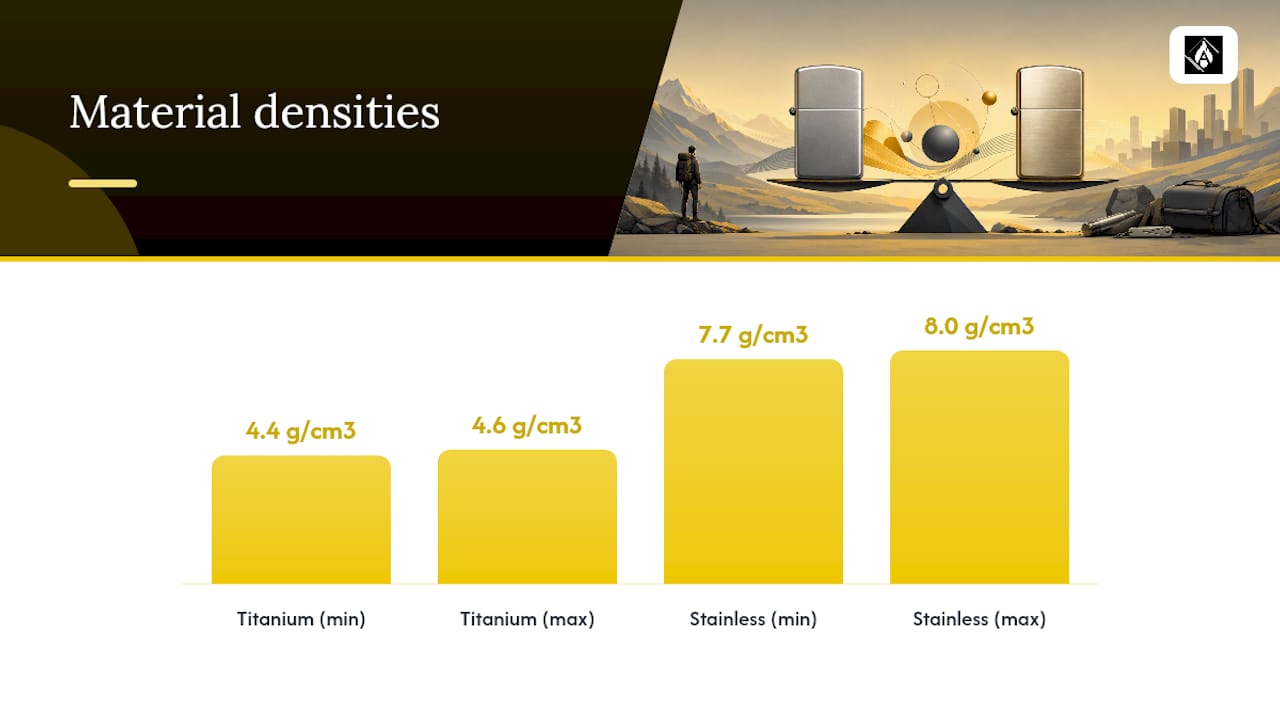
Start with weight, since it’s the difference most people notice first. Titanium runs roughly 4.4 to 4.6 grams per cubic centimeter in density, while stainless steel sits around 7.7 to 8.0 grams per cubic centimeter. That means titanium is about 40 to 45% lighter than stainless steel at the same volume. A stainless lighter that weighs 3 ounces in your pocket has a titanium counterpart noticeably lighter. For a torch lighter carried daily in a jacket pocket, that’s the difference between forgetting it’s there and noticing every reach.
Stiffness tells a different story, and it favors stainless. Stainless steel has an elastic modulus of roughly 190 to 210 GPa, while titanium sits at about 100 to 120 GPa. A higher modulus means stainless resists bending and flexing under load more than titanium does. Titanium compensates with superior strength relative to its weight. It bends before it snaps, and it does so while carrying a fraction of the mass, which is exactly why aerospace engineers favor it for load-bearing parts that also need to stay light.
Corrosion resistance splits along similar lines. Titanium forms a stable titanium dioxide layer that resists most acids, salt, and sweat exposure, which matters if you carry a lighter against your skin in humid climates or near the ocean. Stainless steel’s chromium oxide layer performs well too, but crevice corrosion can develop in tight seams or hinge pockets if the grade or finish isn’t right.
Heat behavior matters most for torch and jet-flame lighters, where the burner sits close to the body. Titanium’s lower thermal conductivity means heat doesn’t travel through the case as fast, so the exterior can stay cooler to the touch even as internal components run hot. Stainless conducts heat more readily, which can make the case warmer during extended use but also lets heat dissipate faster overall.
Cost follows machinability. Titanium requires more specialized tooling and generates faster tool wear, which raises fabrication costs compared to stainless. That’s the primary reason titanium lighters carry a premium: it’s not the raw material alone, it’s what it takes to shape it.
Quick comparison:
- Weight: titanium roughly 40 to 45% lighter by volume
- Stiffness: stainless steel roughly 60 to 90% higher elastic modulus
- Corrosion: both resist typical exposure; titanium edges out in salt and sweat
- Heat transfer: titanium runs cooler to the touch; stainless dissipates heat faster
- Cost: titanium costs more to machine and finish
How These Differences Play Out in Daily Carry
Numbers on a data sheet only matter once they show up in your pocket. Here’s how the material comparison translates into decisions you’ll actually feel.
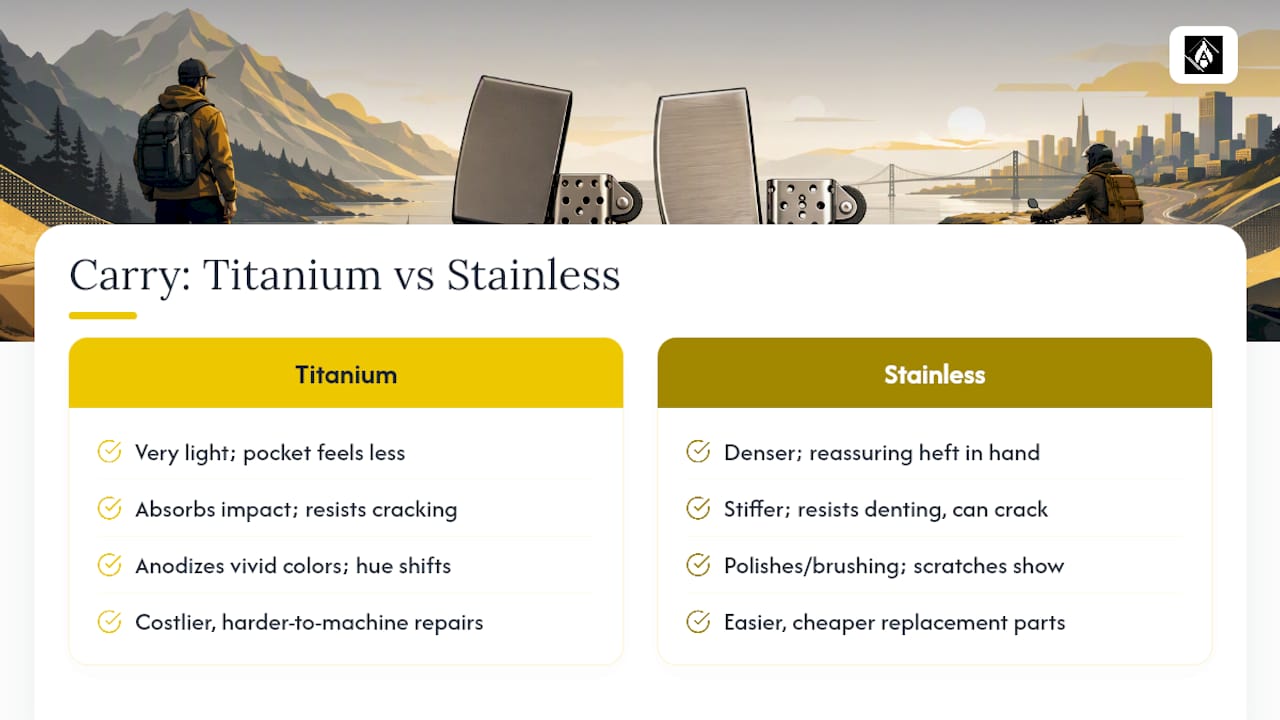
1. Ergonomics and hand feel. A lighter’s weight changes how substantial it feels, and that’s subjective territory. Some carriers want a lighter that vanishes in the pocket; others want the reassuring heft of a solid stainless build. EDC practitioners split on this almost evenly: some value titanium specifically for reduced pocket weight, while others prefer the denser, more grounded feel of stainless steel in hand.
2. Durability under abuse. Stainless steel’s higher stiffness makes it more resistant to denting from drops onto hard surfaces, since it deflects less before it deforms. Titanium tends to absorb impact rather than resist it outright, which sounds worse until you consider that this same flexibility helps it avoid the kind of stress cracking that thinner stainless components can develop after years of hinge cycling.
3. Finish and aging. Titanium can be heat anodized to produce vivid colors, ranging from deep blues to golds, purely through controlled oxidation rather than paint or plating. Stainless steel takes polishing, brushing, and plating well but doesn’t offer that same native color range. Neither finish stays pristine forever; stainless can pick up fine scratches that show as bright lines against a polished surface, while anodized titanium can shift slightly in hue with years of pocket friction and UV exposure.
4. Maintenance and repair. Metal-bodied, refillable lighter designs have a decades-long track record of serviceability, and that logic applies to both materials here. Stainless is easier and cheaper to machine for replacement parts, which usually means faster, less expensive repairs. Titanium repairs cost more because of the same tooling and wear issues that raise its original manufacturing price.
The main downsides in plain terms: titanium costs more and dents less predictably. Stainless weighs more and shows scratches more visibly.
Pro Tip: If you’re torn between the two, carry a coin-sized sample of each material for a day. The weight difference registers within hours, and it usually settles the decision faster than any chart.
Which Allure Cart Lighter Fits Your Carry Style?
Material choice should follow how you actually use a lighter, not which spec sheet sounds more impressive. Three buyer types tend to show up again and again among collectors and everyday carriers.
If you want low weight and dependable flame in windy conditions, the JET LIGHTER is built for that job. Its torch mechanism benefits from the heat behavior differences covered above, staying reliable outdoors where standard flame lighters struggle.
If finish and visual character matter more than raw specs, the TIGER LIGHTER leans into design first. It’s built for buyers who see a lighter as a statement piece as much as a tool, the kind of person who’d rather talk about the engraving than the alloy.
If you’re drawn to distinctive form factors and a heavier, more substantial feel, the BULLET SHELL LIGHTER delivers that collector-grade presence. Its shape alone makes it a conversation piece before it is ever lit.
Every lighter is built around two priorities: reliable spark ignition and a design that stands apart from mass-market options. Shipping policies vary and should be confirmed on the vendor’s site. None of these three products competes on spec sheets alone. Each one serves a different priority: heat performance, aesthetic statement, or physical presence in the hand.
What Happens When You Drop a Titanium or Stainless Lighter?
Drop tests reveal the real gap between “strong” and “stiff,” and it’s a distinction most buyers never learn until they’ve dropped a lighter on concrete.
Stainless steel’s higher stiffness means it resists deformation up to a point, but once that point is exceeded, it tends to dent rather than flex back. A stainless lighter dropped onto a hard tile floor is more likely to show a visible ding at the point of impact, particularly on thinner-walled bodies or where the hinge meets the case.
Titanium behaves differently because of its lower modulus. It flexes slightly on impact and tends to spring back toward its original shape rather than holding a permanent dent. This doesn’t mean titanium is indestructible. Sharp, concentrated impacts, like a corner strike against a metal edge, can still scratch or gouge the anodized surface layer, and repeated drops from height can eventually fatigue any thin-walled metal component.
The mechanism matters as much as the shell. Hinges and ignition wheels see repeated stress cycles regardless of body material, and that’s usually where a lighter fails first, not the outer case. A well-machined hinge in either material will outlast a poorly fitted one, which is why fabrication quality often matters more than the raw alloy when it comes to surviving years of drops.
For pocket carry specifically, the practical takeaway is this: titanium tends to shrug off everyday drops without visible damage, while stainless is more prone to cosmetic dents that don’t affect function but do affect looks over time.
Does Butane or Lighter Fluid React With the Metal Case?
Both titanium and stainless steel resist chemical attack from standard lighter fuels, so fuel choice isn’t a major factor in picking between them.
Butane, used in jet and torch lighters, is a stable hydrocarbon gas that doesn’t meaningfully react with either metal under normal use. Neither titanium’s oxide layer nor stainless steel’s chromium oxide layer show measurable degradation from butane exposure, even with frequent refilling.
Lighter fluid, the naphtha-based fuel used in wick-style lighters, is slightly more aggressive as a solvent but still poses minimal risk to either metal casing. The bigger concern with lighter fluid isn’t the metal body. It’s the felt or cotton wadding inside, which degrades over time regardless of what the exterior is made from.
Where the two materials diverge slightly is at the seams and fuel intake valve. Stainless steel’s crevice corrosion risk, mentioned earlier in the context of sweat and humidity, applies here too if fuel residue sits in tight gaps for extended periods without cleaning. Titanium’s more stable oxide layer handles that kind of low-level chemical exposure with less concern.
Practically speaking, neither material requires special fuel precautions. Wipe down the exterior occasionally, especially around the fill valve, and either metal will handle years of refilling without corrosion issues tied specifically to the fuel itself.
How Do Titanium and Stainless Lighters Age Over Years of Carry?
Long-term wear tells you more about a lighter than any spec sheet, because pocket carry is a slow, cumulative stress test that reveals what a material actually does under friction and repeated handling.
Stainless steel develops what collectors sometimes call “pocket patina”: fine scratches that accumulate on polished surfaces, gradually softening a mirror finish into a satin texture. On brushed stainless, this wear is less visible since the surface already has directional texture built in. Either way, stainless doesn’t discolor chemically under normal conditions. What changes is surface texture, not color.
Titanium ages differently depending on its finish. Bare or bead-blasted titanium develops a similar scratch patina to stainless over time. Anodized titanium, though, can show subtle shifts in color intensity after years of UV exposure and friction, since the anodized layer is a thin oxide coating rather than a dye. Collectors often see this as a feature rather than a flaw. It’s proof of a lighter’s history rather than a sign of neglect.
Neither material rusts in the traditional sense. That’s one of the clearest advantages both share over cheaper plated alloys, which can show reddish corrosion spots within a year or two of regular pocket carry. The practical difference after five or ten years of daily use comes down to this: stainless shows wear as texture change, titanium shows wear as either texture change or, on anodized pieces, a gradual mellowing of color.
Does Material Affect How Reliably a Lighter Lights?
Ignition reliability depends far more on the mechanism, flint quality, and fuel system than on whether the body is titanium or stainless steel, but thermal properties do play a small supporting role.
Torch and jet lighters rely on a stable ignition chamber where fuel and spark meet consistently. Titanium’s lower thermal conductivity means the area right around the burner can retain heat slightly longer between uses, which some torch lighter designs use to their advantage for faster relight in windy conditions. Stainless steel conducts that heat away faster, which isn’t a disadvantage for ignition itself but does mean the body cools down more quickly after use.
Neither material affects the flint, piezo spark, or fuel valve, which are the actual components responsible for ignition reliability. A poorly calibrated stainless lighter will misfire just as often as a poorly calibrated titanium one. Material choice here is a secondary factor at best, and buyers chasing “which metal lights better” are usually asking the wrong question. The right question is which mechanism and fuel system the manufacturer built into that specific model, since that’s what determines whether a lighter fires on the first strike or the fifth.
Which Material Has a Smaller Environmental Footprint?
Neither titanium nor stainless steel is the clear environmental winner, but they carry different trade-offs across production and disposal.
Titanium extraction and refining require more energy-intensive processes than stainless steel production, largely because of the higher machining and fabrication demands discussed earlier. That energy cost happens upfront, during manufacturing, rather than during the product’s life. Once a titanium lighter is made, though, its durability and corrosion resistance mean it can stay in service far longer than cheaper alternatives, spreading that manufacturing footprint over more years of use.
Stainless steel benefits from a more mature, efficient recycling infrastructure. Scrap stainless is widely recyclable and commonly reprocessed into new steel products with minimal quality loss. Titanium is also recyclable, but the recycling infrastructure for it is less developed and less widespread compared to stainless, since titanium scrap volumes are smaller overall.
The most sustainable lighter, regardless of material, is one that gets refilled and repaired for years rather than replaced. That’s the real environmental argument for either metal over disposable plastic lighters: a well-made stainless or titanium lighter, refilled hundreds of times over a decade, avoids the disposal volume that comes with cheap, single-use alternatives ending up in landfills every few weeks.
The Collector’s View: When Feel Beats Specs
Modulus numbers and density charts matter less once a lighter earns a permanent spot in your pocket. Collectors often chase something specs can’t capture: how a piece feels after a year of carry, how the anodizing has mellowed, how the weight sits in your palm before you even flick it open.
That’s part of why titanium commands a premium beyond its strength-to-weight numbers. The colorability from heat anodizing turns a utilitarian metal choice into a personal aesthetic statement, something no stainless finish quite replicates. Stainless still earns its place for buyers who want a lighter with heft and history rather than novelty.
The trait worth prioritizing is the one you’ll notice every single day, whether that’s the near-weightless carry of titanium or the substantial, grounded feel of stainless in your hand.
— Allurecart
Ready to Choose Your Lighter? Here’s Where to Start
It is helpful to compare materials directly rather than rely solely on spec sheets. Designs often pair specific material choices with carry priorities to suit different user needs.
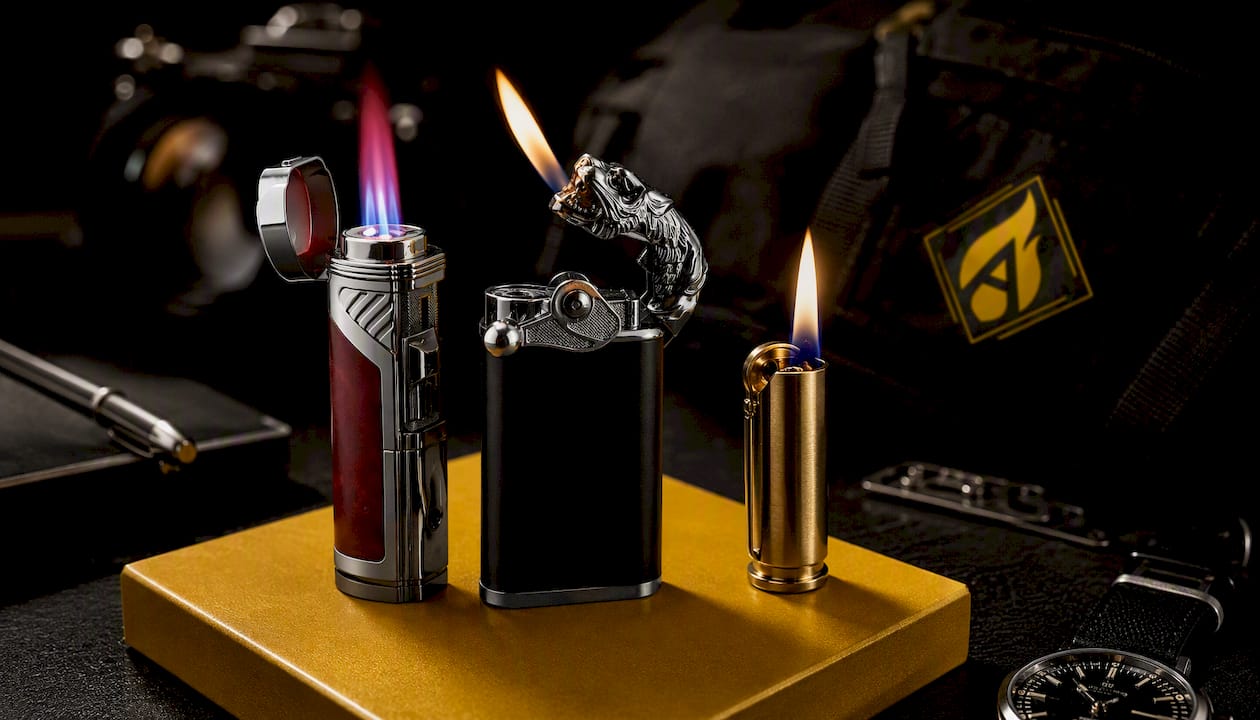
If wind resistance and torch-strength flame matter most, start with the Windproof Jet Torch Lighter. Buyers who want a compact, conversation-starting design should look at the Windproof Watch Lighter, while collectors drawn to a vintage stainless aesthetic will find the Vintage Watch Lighter hits that note directly.
Before you buy, decide on finish first, since anodized titanium colors and brushed stainless tones age differently over years of carry. Confirm the fuel type each model takes and follow the refill instructions listed on its product page. Every order over $70 ships free worldwide, and warranty and returns details are listed on each product page before checkout. Browse the full collection of lighters to compare finishes side by side, or check the accessories if you need refill tools or cases to go with your new pick. Readers who also enjoy cigars might find this guide on cigar etiquette useful for pairing the right lighter technique with the right occasion.
Sources
The mechanical property comparisons in this guide draw on peer-reviewed data on stainless steel and titanium alloys, industry analysis on density and strength differences between the two metals, and a manufacturing perspective on machining costs and material selection. These sources cover the modulus, density, and fabrication figures cited throughout.
- Mechanical properties of stainless steels and titanium alloys (PMC)
- Stainless Steel vs Titanium: Differences, Strength & Uses — Kongfangmetal
- Titanium or Stainless Steel: Which Material Is Better? — JLCCNC
FAQ
What Are the Downsides of Using Titanium in a Lighter?
Titanium costs more to manufacture because it requires specialized tooling and generates faster tool wear during machining, which raises the price of the finished lighter. It also has a lower elastic modulus than stainless steel, meaning it flexes more under load, though this actually helps it resist permanent denting from drops.
Is Titanium Worth It Over Stainless Steel for a Lighter?
It depends on what you value most in daily carry. Titanium is worth the premium if you want a lighter that’s roughly 40 to 45% lighter by volume and resists corrosion from sweat or humidity, while stainless steel is the better value if you prioritize a lower price and a heavier, more substantial hand feel.
What Is the Lightest but Strongest Metal Used in Lighters?
Titanium offers the best strength-to-weight ratio of the two materials commonly used in premium lighters, thanks to its lower density paired with high tensile strength. Stainless steel is stiffer and often matches or exceeds titanium’s absolute tensile strength depending on the grade, but it carries significantly more weight to achieve that.
Which Is Lighter, Titanium or Aluminum?
Titanium and aluminum are both far lighter than stainless steel, but aluminum is generally less dense than titanium, making it the lighter of the two by volume. Aluminum is rarely used for premium lighter bodies, though, since it lacks the strength and corrosion resistance that make titanium and stainless steel the standard choices for durable, long-term carry.