

For small to medium ring gauges, a single-jet torch delivers precise, fuel-efficient toasting that protects flavor. For thick, large-ring cigars or windy outdoor sessions, a triple-jet torch wins on ignition speed and even coverage. The tradeoff runs simple: single jets favor control and fuel economy, triple jets favor raw speed and reliability under pressure. Both formats are available in the market, so the right pick comes down to what’s in your humidor.
TL;DR:
- Triple-jet torches ignite large ring cigars faster and provide better wind resistance, but they consume fuel more quickly and require more maintenance.
- Single-jet lighters offer greater control, fuel efficiency, and are better suited for small to medium cigars, especially in stable conditions.
- Proper maintenance, including cleaning jets and using high-quality butane, significantly improves ignition reliability for both torch types.
- Altitude and wind conditions influence performance, with triple jets generally performing more consistently outdoors and at higher elevations.
- Overall, choice depends on cigar size, smoking environment, and portability preferences, not jet count alone.
Table of Contents
- Single Jet vs Triple Jet: A Quick Comparison
- How Single and Triple Jets Actually Work
- Heat, Wind, and Altitude: What You’ll Actually Notice
- Fuel Efficiency: Burn Rate and Tank Size
- Keeping Your Torch Reliable Over Time
- Matching Jet Count to Cigar Size
- A Fast Way to Choose the Right Lighter
- Why Allurecart’s Lineup Covers Both Use Cases
- Author Note From Allurecart
- Find Your Match in the Allurecart Collection
- Sources
- FAQ
Single Jet vs Triple Jet: A Quick Comparison
Before you settle on a lighter, it helps to see how each format stacks up across the factors that actually matter at the foot of a cigar.
- Performance and ignition speed: Triple jets ignite large surfaces faster because three flames strike the foot simultaneously; single jets take a few extra seconds but concentrate heat more precisely.
- Flame coverage: A single-jet torch produces one narrow, hot core, while a triple-jet design spreads three overlapping cores across a wider surface.
- Fuel use: Single jets sip butane per light; triple jets burn through fuel faster but need fewer passes to fully light a cigar.
- Maintenance risk: More jets mean more nozzles that can clog, so triple-jet models generally demand more frequent cleaning.
- Best-for ring gauge: Single jets suit smaller cigars; triple jets shine on thick, large-ring cigars.
If you smoke a rotation of different sizes, the choice isn’t really single versus triple. It’s about matching the tool to what’s actually in your pocket that day.
How Single and Triple Jets Actually Work
A single-jet lighter forces butane and air through one nozzle, producing a narrow, blowtorch-like flame that concentrates heat into a small point. That precision is why old-school cigar smokers favor it for the “toast and draw” technique, rotating the foot slowly to build an even ember without scorching the wrapper.
Triple jets change the physics. Three nozzles fire flames close enough together that they merge into one wider combustion zone. Fluid dynamics research on multi-jet configurations shows that adjacent jets interact through increased shear and spreading as they mix, which is exactly why triple-jet flame patterns overlap into a broader, hotter working surface instead of staying as three separate points.
Heat, Wind, and Altitude: What You’ll Actually Notice
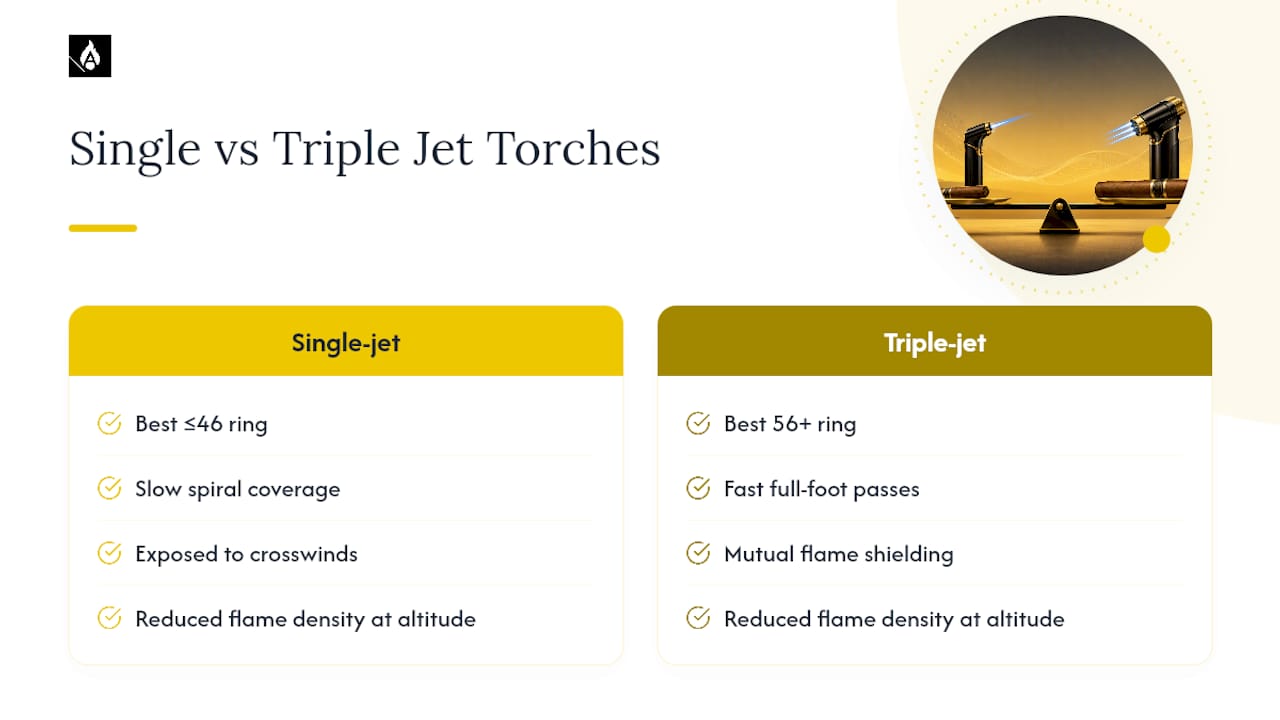
Ignition speed is the most obvious difference. On a wide-ring cigar, three overlapping flames toast the entire foot in one or two passes, while a single jet often needs a slow spiral to cover the same area evenly.
Wind resistance follows the same logic. Multiple flames packed close together shield each other from crosswinds better than one exposed jet, which is why patio and golf-course smokers tend to reach for multi-jet torches. Altitude changes the math too: thinner air at elevation reduces flame density regardless of jet count, so both types can sputter above a few thousand feet. Running the flame adjuster toward its higher setting and giving the torch a few extra seconds to stabilize before lighting solves most altitude-related misfires.
Reliable ignition often comes down to construction more than jet count. A well-built torch with a quality piezo igniter will outperform a cheaper multi-jet model even in gusty conditions, so don’t assume more flames automatically means more reliability.
Fuel Efficiency: Burn Rate and Tank Size
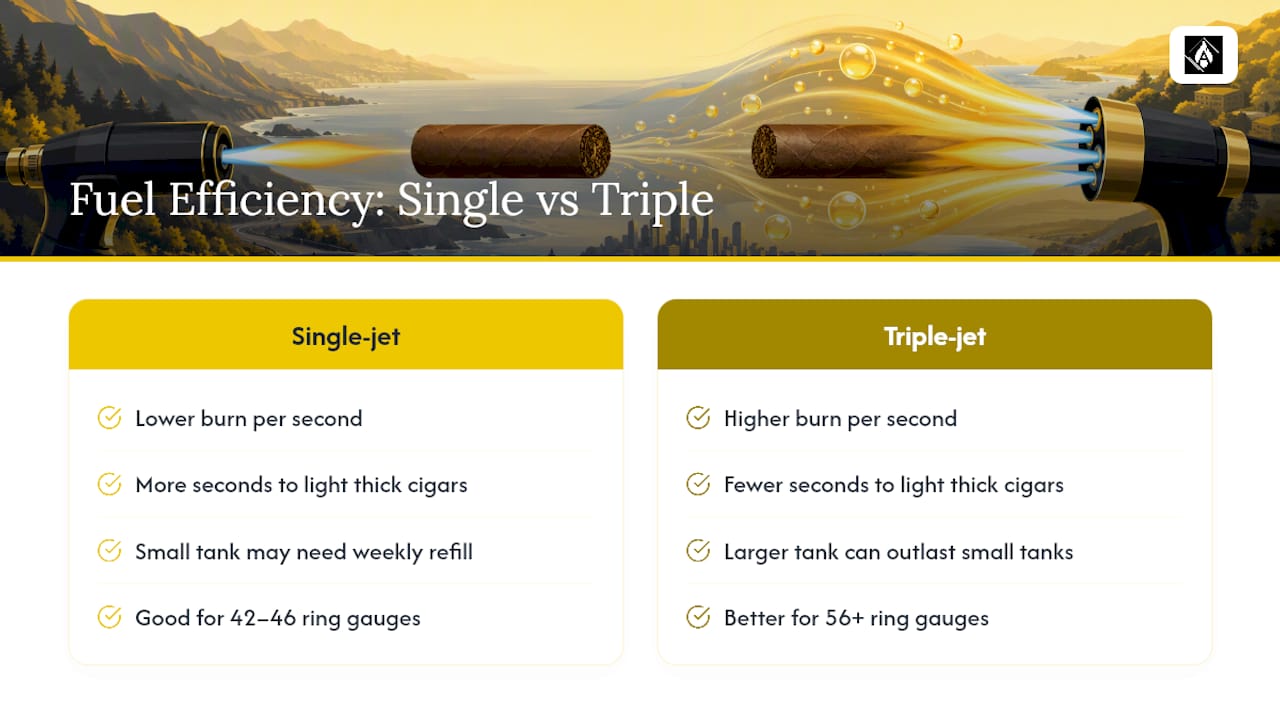
Triple jets burn butane faster per second of use, but they typically need fewer total seconds to light a cigar, especially a thick one. Single jets sip fuel slowly and can stretch a tank across more sessions, particularly for smokers who favor 42 to 46 ring gauges.
Tank size matters as much as jet count. A compact single-jet lighter with a small reservoir might need refilling every week for a daily smoker, while a triple-jet model with a larger tank can outlast it despite the higher burn rate. If you travel with your torch, check the listed fuel window and refill before it runs low, since a half-empty tank is the most common cause of a weak or uneven flame.
Keeping Your Torch Reliable Over Time
Clogged jets are almost always the result of low-quality butane, moisture in the tank, or letting the reservoir run dry and drawing in air. Triple-jet torches have three chances to foul instead of one, so they reward a bit more upkeep.
A basic maintenance routine keeps any jet lighter firing cleanly:
- Bleed the tank completely before refilling, holding the valve open until no more gas escapes.
- Refill slowly with high-purity butane, keeping the can upright and matching the nozzle to the fill valve.
- Let the lighter sit for two minutes before testing to let the fuel settle.
- Inspect each jet visually and clear debris with a soft brush or a fine pin, never a metal tool that could widen the nozzle.
- Test-fire in a still room; a weak, sputtering, or uneven flame signals it’s time for a deeper cleaning or service check.
Pro Tip: Cheap butane is the number one cause of clogged jets. Spend the extra dollar or two on a refined, multiple-filtered fuel and you’ll cut your cleaning frequency dramatically.
Matching Jet Count to Cigar Size
Ring gauge should drive this decision more than personal preference alone, though technique still matters within each category.
- 46 ring gauge and under: A single-jet torch gives you the control to toast slowly without overheating a delicate wrapper.
- 48 to 54 ring gauge: Either format works; single jets reward patience, while a dual or triple jet speeds things up if you’re lighting on the move.
- 56 ring gauge and above: A triple-jet torch handles the wide foot in one or two passes, cutting the risk of an uneven burn known as canoeing.
- Technique note: With a single jet, rotate the cigar continuously and keep the flame just off the foot. With a triple jet, hold it slightly farther back since the combined heat is more intense at close range.
A Fast Way to Choose the Right Lighter
Cut through the options with a short mental checklist before you buy:
- Identify the ring gauge you smoke most often. That single number narrows the field faster than any spec sheet.
- Factor in where you smoke. Outdoor, windy, or high-altitude settings push the decision toward triple jets.
- Weigh portability against fuel economy. Single jets are typically slimmer and sip less fuel; triple jets run bigger and thirstier.
- Confirm four things before checkout: visible fuel window, adjustable flame height, a reliable ignition switch, and a warranty that covers the ignition mechanism.
If your answers split evenly, a dual-jet or adjustable multi-jet model often bridges the gap without forcing a hard choice.
Why Allurecart’s Lineup Covers Both Use Cases
Allurecart’s catalog reflects exactly this split. For precision toasting on smaller rings, a JET LIGHTER delivers the focused single flame that suits everyday smoking. For thicker cigars or outdoor use, the BULLET SHELL LIGHTER and windproof multi-jet models handle wider feet and breezy patios without hesitation.
Before buying from any lineup, verify three specs: jet count, visible fuel window, and flame adjuster range. Those three details predict real-world performance far better than styling alone, though Allurecart’s designs never make you choose between the two.
Author Note From Allurecart
Every jet configuration involves tradeoffs. No lighter fixes bad technique, and no gadget replaces a slow, deliberate toast. We built our lineup around that reality, not around chasing jet counts for their own sake. If you’re unsure which model fits your rotation, reach out. We’d rather help you choose right than sell you the wrong torch.
— Allurecart
Find Your Match in the Allurecart Collection
Allurecart is the practical alternative to guessing your way through a wall of look-alike torches online. Many listings state jet count, fuel window, and flame adjuster range up front, helping match specs to your humidor instead of hoping for the best.
If precision toasting on smaller rings is your priority, the JET LIGHTER and ACE OF SPADES LIGHTER both offer a single, concentrated flame built for control. For wider ring gauges or outdoor sessions, the Windproof Jet Torch Lighter handles gusty patios with ease, while the BULLET SHELL LIGHTER and LOST SOULS LIGHTER add a collector’s edge to everyday performance. Collectors chasing something different can browse the CLOCK LIGHTER and LUMINO LIGHTER for statement pieces that still light reliably.
Orders over $70 ship free worldwide, so it’s worth pairing a daily-use torch with a display piece like the Vintage Watch Lighter or RETRO LIGHTER in one checkout. Browse the full lineup and pick the jet count that matches your humidor today.
Sources
- Three’s Company with These Top-Rated Triple Jet Torches — Oaks Cigar
- Selecting a lighter - Cigar 101 Knowledge — Famous-Smoke
- Experimental study on mean flow characteristics of a supersonic multiple jet configuration — Elsevier (DOI)
FAQ
Which brand of jet lighter is the most reliable?
Reliability tracks build quality and ignition mechanism more than brand name alone. A torch with a sturdy piezo ignition and a clear fuel window, like the models in Allurecart’s JET LIGHTER line, tends to outperform cheaper multi-jet lighters regardless of label.
How much hotter is a torch than a standard lighter?
Torch lighters burn hotter and more consistently than open-flame disposable lighters because the jet design forces a pressurized, oxygen-rich flame. Triple-jet torches concentrate that heat across a wider area, which is why they light thick cigars faster than a standard flame.
What is considered the best cigar lighter?
There’s no single best lighter. The better question is fit: a single-jet torch suits precision toasting on smaller rings, while a triple-jet model suits speed and even coverage on large-ring cigars or outdoors.
Which brand of jet flame lighter is the best?
The strongest choice depends on your typical cigar size and smoking environment rather than brand alone. Checking fuel window, flame adjuster range, and ignition quality, features found across Allurecart’s jet lighter catalog, matters more than chasing a specific label.