

For everyday indoor use, a piezo push-button wins on low maintenance and instant fire. For rugged outdoor use, a flint-and-wheel lighter wins on wind resilience and field repairability. Both systems can last for years, but they demand different habits from the person carrying them.
TL;DR:
- Wind resistance is critical; flint lighters with torch flames perform better outdoors, especially in gusty conditions, than piezo push-button models.
- Flint systems require periodic reflinting and are more repairable with simple parts, making them preferable for long-term collectors and rugged use.
- Piezo lighters offer minimal maintenance and are ideal for indoor daily use, but their internal springs and hammers tend to fail first, especially with heavy or rough handling.
- Overall durability depends more on build quality than ignition type; sturdy metal housings and craftsmanship extend lifespan for both systems.
- For those seeking convenience and forgettable upkeep, piezo lighters are best, while outdoor users benefit most from windproof, torch-style flint devices.
Table of Contents
- Piezo vs Flint: A Quick Practical Comparison
- How Do Flint and Piezo Ignition Actually Work?
- How Long Does Each Ignition System Actually Last?
- Which Ignition Is Easier to Use and Maintain?
- What Does Each Type Cost to Buy and Repair?
- What Allurecart Recommends for Your Ignition Priorities
- Your Ignition Checklist: Piezo, Flint, or Both?
- Why the “Which Is Better” Debate Misses the Point
- Find Your Match in the Allurecart Collection
- Sources
Piezo vs Flint: A Quick Practical Comparison
The two systems solve the same problem, ignition, through completely different physics. A flint wheel is mechanical friction. A piezo mechanism is a controlled electrical jolt. That distinction shapes everything else about how each performs in your pocket, your car, or a campsite.
Here’s how they stack up at a glance:
- Spark method: Flint uses a rotating wheel scraping a mischmetal rod; piezo uses a spring-loaded hammer striking a quartz crystal to generate voltage.
- Best for indoor, low-maintenance use: Piezo. One click, no flint to track, no wheel to spin.
- Best for outdoor, high-wind use: Flint-and-wheel, especially paired with a torch-style windproof flame.
- Best for collectors: Flint wheels, since the tactile mechanism and classic metal housings carry more character piece for piece.
- Maintenance: Flint needs periodic reflinting; piezo needs almost none until the internal spring or crystal fails.
- Typical lifespan: Piezo crystals can survive an enormous number of strikes, but the hammer spring around them often gives out first.
- Wind resistance: Flint sparks tend to catch more reliably in gusty conditions than a single piezo click, particularly on cheaper units.
Flint lighters are commonly preferred outdoors for wind resistance and ruggedness, while piezo push-button lighters get favored for effortless indoor everyday use, and that split holds up across most real-world reviews.
How Do Flint and Piezo Ignition Actually Work?
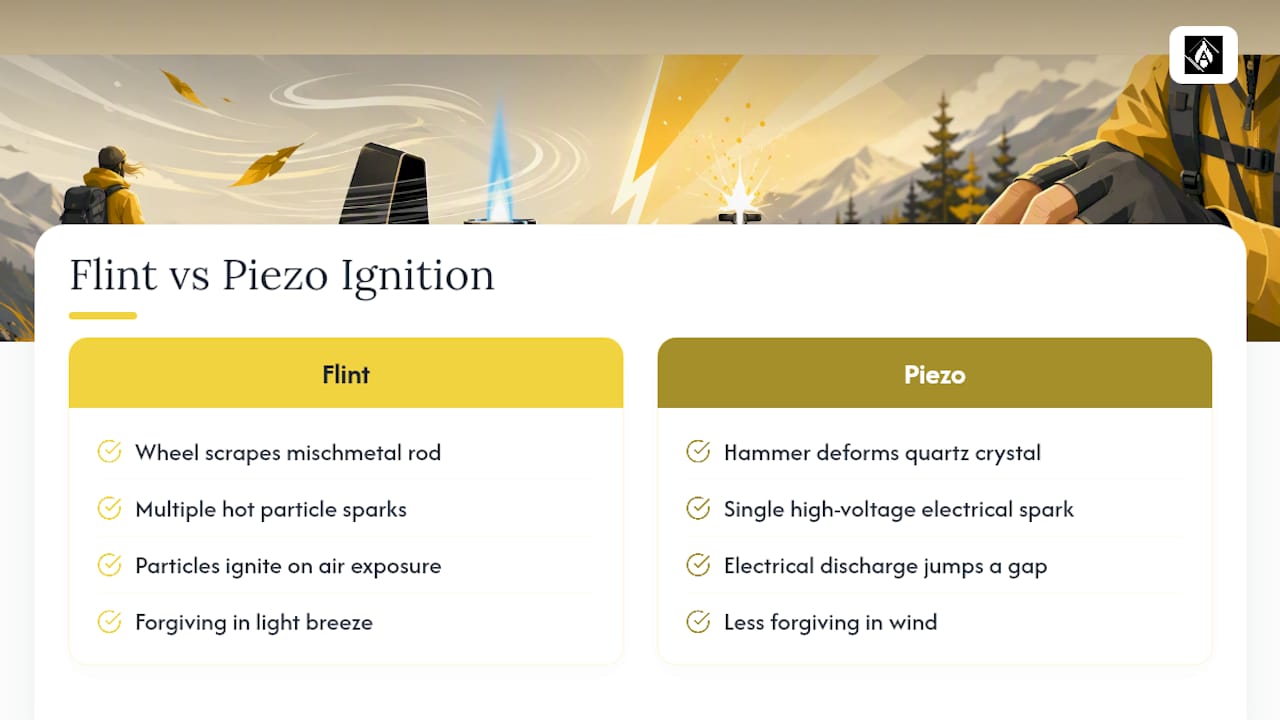
A flint-and-wheel lighter is pure mechanical friction, the same principle that’s ignited fires for over a century. Rolling your thumb across the wheel spins a steel gear against a small rod of mischmetal, an iron-cerium alloy. That contact shears off microscopic particles that ignite instantly on exposure to air, throwing off the visible spark. The flint replacement process documented by manufacturers shows just how simple this scraping mechanism really is under the hood.
Piezoelectric ignition works on a different principle entirely. Pressing the button drives a small hammer into a crystal, usually quartz, which briefly deforms under mechanical pressure. That deformation generates a high-voltage electrical discharge that jumps across a small gap as a single, controlled spark. No burning metal, no friction, just physics doing its thing inside a sealed housing.
The practical difference matters more than it sounds. Flint sparks are a shower of hot particles, forgiving if your aim or timing is slightly off, which is part of why they still ignite reliably in a light breeze. Piezo delivers one precise spark at one exact moment, which is efficient indoors but less forgiving when wind disrupts the fuel stream right as that single spark fires.
How Long Does Each Ignition System Actually Last?
Quartz crystals themselves are remarkably tough. Piezo materials are often longer lasting than flint-based systems because quartz resists wear from repeated strikes in a way that a consumable flint rod simply cannot. But “the crystal survives forever” isn’t the same as “the lighter survives forever.”
The real weak point in most piezo designs isn’t the crystal. It’s the small mechanical hammer and spring that strike it. Wikipedia’s technical breakdown of piezo ignition notes that these small components fail more often than the crystal itself, especially in inexpensive lighters where the spring fatigues after heavy use. Flint systems fail differently: the rod depletes and needs replacing, the spring behind it weakens, or the wheel post gets knocked out of alignment.
Environment changes the math for both. A dropped lighter can bend a flint wheel’s mounting post, a misalignment that’s often unfixable without replacing the whole mechanism. Cold temperatures slow butane vaporization regardless of ignition type. And torch-style piezo lighters can struggle at very high elevations, where thinner air changes how the flame catches.
- Flint failure modes: depleted rod, worn wheel teeth, bent alignment post from drops.
- Piezo failure modes: cracked crystal (rare), broken hammer spring (common), corroded contact points from moisture.
- Community reports split here too: some users trust flint for sheer physical robustness, others have watched piezo buttons quit mid-trip when a spring snapped.
Pro Tip: If you’re buying a piezo lighter for travel, gently test the button firmness in the store. A stiff, solid click usually means a sturdier hammer spring than a loose, mushy one.
Which Ignition Is Easier to Use and Maintain?
Ergonomics come down to a single motion versus a repeated one. A piezo button is a straight push, which makes it noticeably easier for anyone with limited hand strength or dexterity. A flint wheel needs a firm thumb roll, which some users find satisfying and others find fussy in cold weather or with gloves on.
Maintenance separates the two systems further:
- Flint replacement takes just a few steps: pop off the wheel housing, slide out the old flint and spring, drop in a fresh rod, and reseat the assembly. Cricket Lighters’ step-by-step maintenance guide shows this typically requires no special tools on refillable metal designs.
- Piezo servicing is rarer but harder. When the button stops sparking, the fix usually means replacing the entire ignition module rather than a single part.
- Outdoor considerations favor flint’s forgiving spark shower and torch-style piezo units built specifically for wind, like a windproof jet torch design.
What Does Each Type Cost to Buy and Repair?
Mainstream flint lighters generally sit at the lower end of the market, with refillable metal versions costing a bit more upfront but paying that back through cheap, widely available flint rods. Piezo lighters often carry a modest premium for the internal mechanism, but that cost buys years of button presses without buying a single spare part.
- Upfront cost: Flint and piezo lighters overlap heavily in mainstream pricing; premium materials and design drive cost more than ignition type does.
- Ongoing cost: Flint rods are inexpensive and sold everywhere; piezo needs nothing until it breaks, then usually needs a replacement unit.
- Repairability: A metal-housed flint lighter can be serviced almost indefinitely with basic parts, which is why collectors gravitate toward durable metal shell designs.
- Long-term value: A refillable flint lighter with a quality housing often outlasts several cheap disposables, even accounting for the occasional flint swap.
What Allurecart Recommends for Your Ignition Priorities
Allurecart builds its collection around exactly this tradeoff: reliable spark ignition wrapped in designs worth holding onto. The brand’s free worldwide shipping on orders over $70 reflects a broader focus on making premium, design-forward lighters accessible rather than exclusive.
Matched to your priorities, the lineup breaks down clearly:
- Outdoor and wind-heavy use: the JET LIGHTER delivers torch-style, windproof performance where a single spark needs to count.
- Low-maintenance everyday carry: the GLOW LIGHTER suits users who want push-button simplicity without babysitting a flint.
- Collectors and tactile enthusiasts: the TIGER LIGHTER delivers the flint-wheel feel and standout design collectors chase.
Your Ignition Checklist: Piezo, Flint, or Both?
The verdict hasn’t changed: piezo for effortless indoor use, flint-and-wheel for outdoor wind resistance and hands-on durability. What changes is which factor you weigh heaviest.
Run through this before you buy:
- Wind exposure: frequent outdoor use points to flint or a torch-style piezo built specifically for it.
- Maintenance tolerance: if you never want to think about flint rods, piezo wins outright.
- Hand dexterity: a single button press beats a wheel roll for anyone with grip or strength limitations.
- Budget over time: flint costs pennies to maintain; piezo costs nothing until the mechanism eventually fails.
- Aesthetics and collectibility: flint wheels carry more classic mechanical charm for display pieces.
For daily indoor use, buy piezo. For camping, job sites, or anywhere wind is a factor, buy flint or a windproof torch. Many people end up owning one of each.
Why the “Which Is Better” Debate Misses the Point
Most comparisons treat piezo and flint like a competition with one winner, and that framing does readers a disservice. The honest answer is that these two systems were engineered to solve different problems, and asking “which is better” is a bit like asking whether a screwdriver beats a wrench.
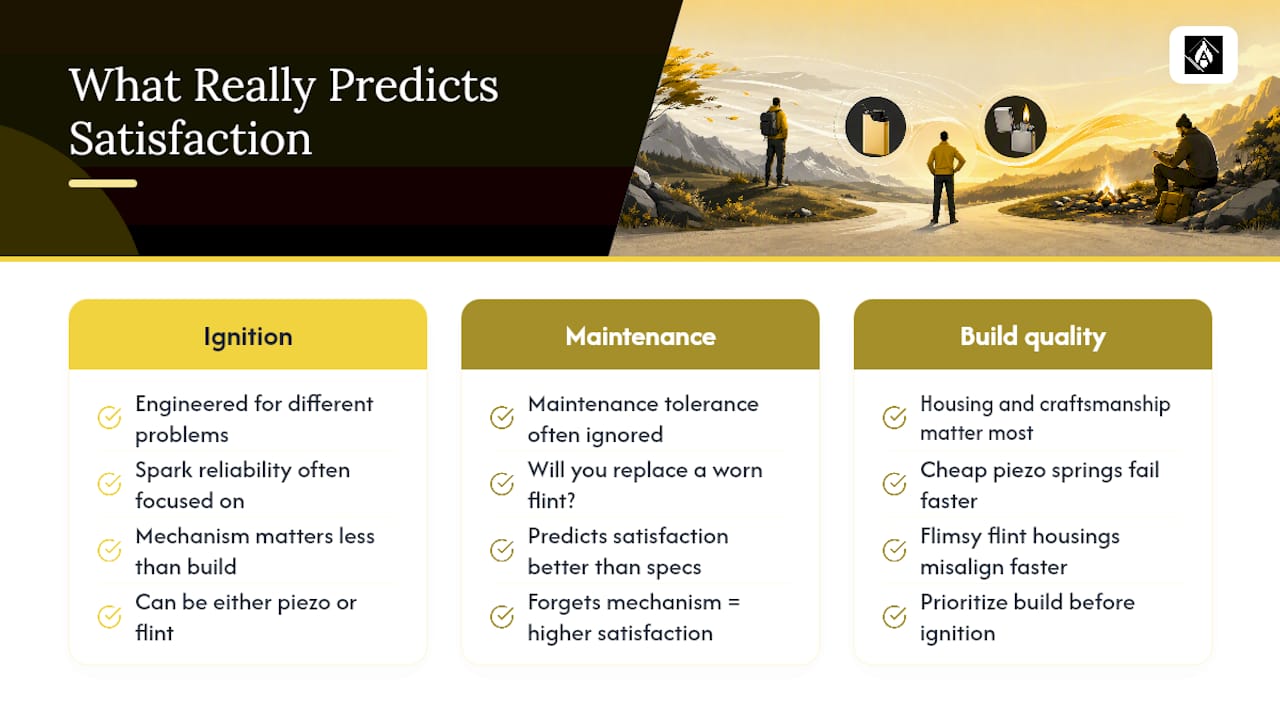
Where conventional advice falls short is in treating maintenance tolerance as an afterthought. Buyers fixate on spark reliability and ignore the more relevant question: are you someone who’ll actually replace a flint rod when it wears out, or someone who wants to forget the mechanism exists entirely? That single answer predicts satisfaction better than any spec sheet.
What deserves more attention is build quality around the ignition, not just the ignition type itself. A cheap piezo hammer spring fails faster than a well-made flint wheel ever will, and a flimsy flint housing misaligns faster than a quality piezo module degrades. The mechanism matters less than what’s built around it. Prioritize the housing and craftsmanship first, then pick the ignition style that matches your actual habits, not your assumptions about which sounds more rugged.
— Allurecart
Find Your Match in the Allurecart Collection
Once you know whether you lean piezo or flint, the harder part is finding a lighter that doesn’t feel disposable either way. That’s the gap Allurecart fills: every design pairs dependable spark ignition with a build worth keeping, whether you’re after a steampunk showpiece or a clean, minimalist everyday carry.
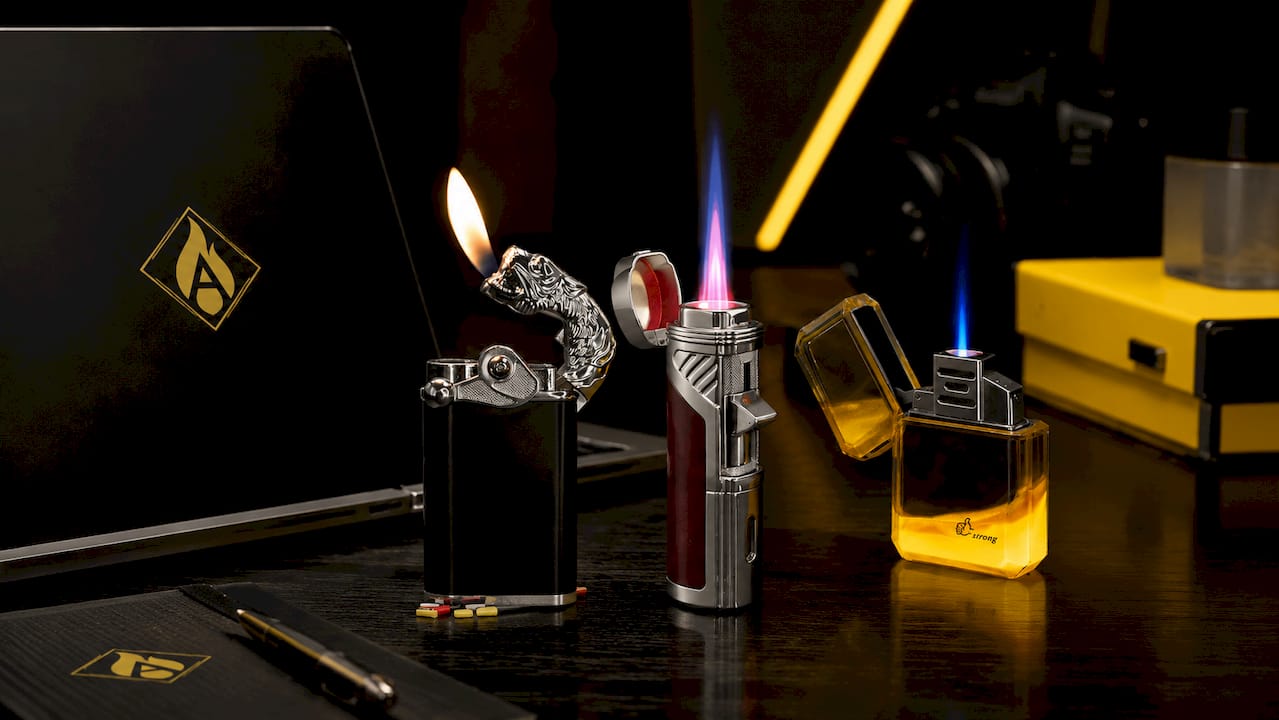
If wind resistance is your priority, the JET LIGHTER gives you torch-style power built for outdoor conditions. If you’d rather never think about maintenance again, the GLOW LIGHTER delivers push-button simplicity with standout design. And if the mechanical wheel action itself is part of the appeal, the Premium Revolver Lighter puts that tactile motion front and center. Orders over $70 ship free worldwide, so browse the collection and pick the ignition that actually fits how you live.
Sources
- Piezo ignition — Wikipedia
- The Mechanics of Flame: Understanding Flint and Electronic Lighters — Cricket Lighters
- How Does a Piezo Electric Ignitor Work? — CheapHumidors