

Lighter design evolved from stationary chemical apparatus in the early 1800s into pocket-sized instruments defined by three pivot inventions: Döbereiner’s lamp in 1823, ferrocerium in 1903, and the windproof Zippo case of 1932. Each solved a distinct problem: spark reliability, one-handed field use, and wind resistance. What follows traces that chronology, the technical shifts inside the case, the styles those shifts produced, and how a modern curator reads that lineage today.
TL;DR:
- The transition from Döbereiner’s chemical lamp to ferrocerium sparks in 1903 enabled the development of pocket-sized lighters.
- World War I drove the standardization of windproof, one-handed trench lighters, influencing modern durable and wind-resistant designs.
- The shift from naphtha to sealed butane valves in the mid-20th century led to slimmer, disposable lighters with injection-molded cases.
- Art Deco and postwar styles shaped lighters as jewelry and symbols of durability, with designs ranging from ornate metalwork to simple plastic disposables.
- Different lighter types suit specific uses, with torch lighters best for outdoors and electric arc models ideal for wind resistance and quick ignition.
Table of Contents
- The History of Lighter Design: A Timeline of Turning Points
- What Technical Pivots Changed Lighter Design?
- How Did Art Deco and Postwar Design Shape Lighter Styles?
- Which Lighter Type Fits Which Use?
- Why Do Some Lighter Designs Become Icons?
- How Allurecart Interprets a Century of Lighter Design
- What Does This Design History Tell Us About What We Actually Value?
- Own a Piece of That Design Lineage
- Sources
The History of Lighter Design: A Timeline of Turning Points
Every design breakthrough in this story answers a practical complaint. Something didn’t fit in a pocket, didn’t survive a gust of wind, or cost too much to make. Tracing the timeline chronologically shows how each frustration produced the next leap forward.
-
1823: Döbereiner’s lamp. German chemist Johann Wolfgang Döbereiner built a glass apparatus where zinc reacted with sulfuric acid to release hydrogen gas, which then streamed over a platinum sponge and ignited spontaneously. It worked reliably, and it earned its place in history as the first widely recognized chemical ignition device. But it stood roughly a foot tall, used corrosive acid, and belonged on a mantel, not in a coat pocket. Calling it a “lighter” in the modern sense stretches the word. It was the proof of concept that fire could be summoned from a controlled chemical reaction rather than flint and steel struck by hand.
-
Late 1800s to early 1900s: the flint-wheel pocket device. Inventors spent the rest of the century shrinking the concept. The real breakthrough arrived in 1903, when Austrian chemist Carl Auer von Welsbach patented ferrocerium, a synthetic alloy engineered to throw hot, reliable sparks when scraped by a rough wheel. That single material innovation made a genuinely pocketable lighter possible for the first time.
-
1914 to 1918: the trench lighter. World War I turned lighter design into a battlefield requirement. Soldiers in the trenches needed a flame that would survive wind, mud, and gloved hands, and they needed to strike it without setting down a rifle. Field workshops and small manufacturers responded with improvised one-handed strikers built from spent shell casings and scrap metal, and historians consistently point to that wartime pressure as the reason windproofing and single-hand operation became standard design expectations rather than luxuries.
-
1932 to 1933: the Zippo. George G. Blaisdell took the trench lighter’s lessons and formalized them into a consumer product. His hinged metal case, chimney vents that shielded the flame from wind, and a lifetime guarantee combined into a design so complete that it barely changed for decades. The windproof chimney design remains the reference point every metal-cased lighter since has been measured against.
Each of these four moments solved the previous generation’s specific failure. Döbereiner solved combustion. Ferrocerium solved portability. The trench lighter solved wind and gloves. The Zippo solved durability and brand trust all at once.
What Technical Pivots Changed Lighter Design?
Three technologies did more to shape the modern lighter’s shape and mechanism than any single designer. Understanding them explains why lighters look and feel the way they do.
- Ferrocerium’s spark chemistry. Welsbach’s 1903 alloy throws sparks hot enough to ignite fuel vapor with a light scrape, which is why every flint-wheel lighter since has been built around a wheel-and-rod mechanism rather than a bulkier flint-and-steel striker.
- Naphtha versus butane. Early 20th-century lighters ran on naphtha, a liquid fuel soaked into a cotton wick, which meant an open reservoir, an evaporation problem, and a distinct chemical smell. The mid-century shift to pressurized butane eliminated the wick entirely, replacing it with a sealed valve that let designers control flame height precisely and build slimmer, sealed cases.
- Piezoelectric and electric ignition. Piezo mechanisms, which generate a spark from mechanical pressure on a crystal, removed the flint wheel altogether by the 1960s. More recently, arc and plasma lighters skip combustible fuel entirely, using a rechargeable battery to arc electricity across two electrodes, which is why they resist wind that would snuff any open flame.
Quick fact: the shift from naphtha wicks to sealed butane valves is the single change most responsible for the disposable lighter’s slim, injection-molded shape, since a valve needs no absorbent core and far less internal volume than a wick-and-reservoir system.
Disposable engineering compounded all three shifts. Once butane and piezo ignition removed the wick and the flint wheel, manufacturers could injection-mold a lighter’s body in one or two pieces, which cut production costs enough to make the entire object disposable rather than refillable.
Pro Tip: If you’re examining an antique lighter’s spec sheet or an auction listing, don’t assume “flint” means stone. Most 20th-century lighter “flints” are actually replaceable ferrocerium rods, an important distinction for anyone restoring or appraising a vintage piece.
How Did Art Deco and Postwar Design Shape Lighter Styles?
Fire mechanisms determined how a lighter worked. Visual movements determined what it meant to carry one. The 1920s and 1930s Art Deco movement treated the pocket lighter as jewelry, favoring geometric engraving, enamel inlay, and precious-metal plating that turned a fire-starting tool into a visible status marker at a dinner table or card game.
Zippo’s postwar strategy took a different route entirely. Instead of ornament, the brand built its identity around the brushed-chrome case and a lifetime repair guarantee, which meant the design story was about durability rather than decoration. That single decision, betting on longevity as the selling point, is arguably why so many originals still function today.
- Luxury artisan lighters kept the metalwork tradition alive with hand-finished brass, sterling silver, and enamel work aimed at collectors who wanted craftsmanship over convenience.
- Mass-market plastic disposables, arriving alongside cheap injection molding, made novelty color and shape available to anyone rather than only those who could afford metalwork.
- Modern novelty and hybrid pieces, including watch-styled lighters and mechanical steampunk designs, revive Deco-era ornamentation and trench-lighter miliaria motifs using materials and manufacturing precision those earlier eras never had.
Allurecart’s catalog sits squarely in that last lineage. A gold-finished classic lighter echoes the Deco instinct toward metal as a status object, while a Camel-style vintage design borrows directly from mid-century pocket-lighter proportions and case styling.
Which Lighter Type Fits Which Use?
Fuel and ignition choices are not interchangeable, and picking the wrong type for the job is the most common mistake buyers make. Each design solves for a different combination of flame control, wind resistance, and refill convenience.
- Naphtha soft-flame lighters burn a wick-fed liquid fuel that produces a warm, yellow flame. Vintage Zippo-style cases still favor naphtha because the flame is easy to shield and pleasant to look at, though it evaporates over time even unused.
- Butane soft-flame lighters deliver a cleaner, controllable flame with no lingering fuel odor, making them the standard choice for everyday cigarette use.
- Torch or jet lighters force butane through multiple nozzles to create a high-temperature, wind-resistant flame, which is why cigar smokers favor them over soft-flame designs that struggle outdoors.
- Electric arc and plasma lighters replace fuel entirely with a rechargeable high-voltage arc, and their flameless design shrugs off wind that would kill any open flame.
The trade-off underneath all four types is refillable durability against disposable convenience. A metal-cased butane lighter can outlast its owner with basic maintenance; a molded disposable is built to be replaced, not repaired.
Why Do Some Lighter Designs Become Icons?
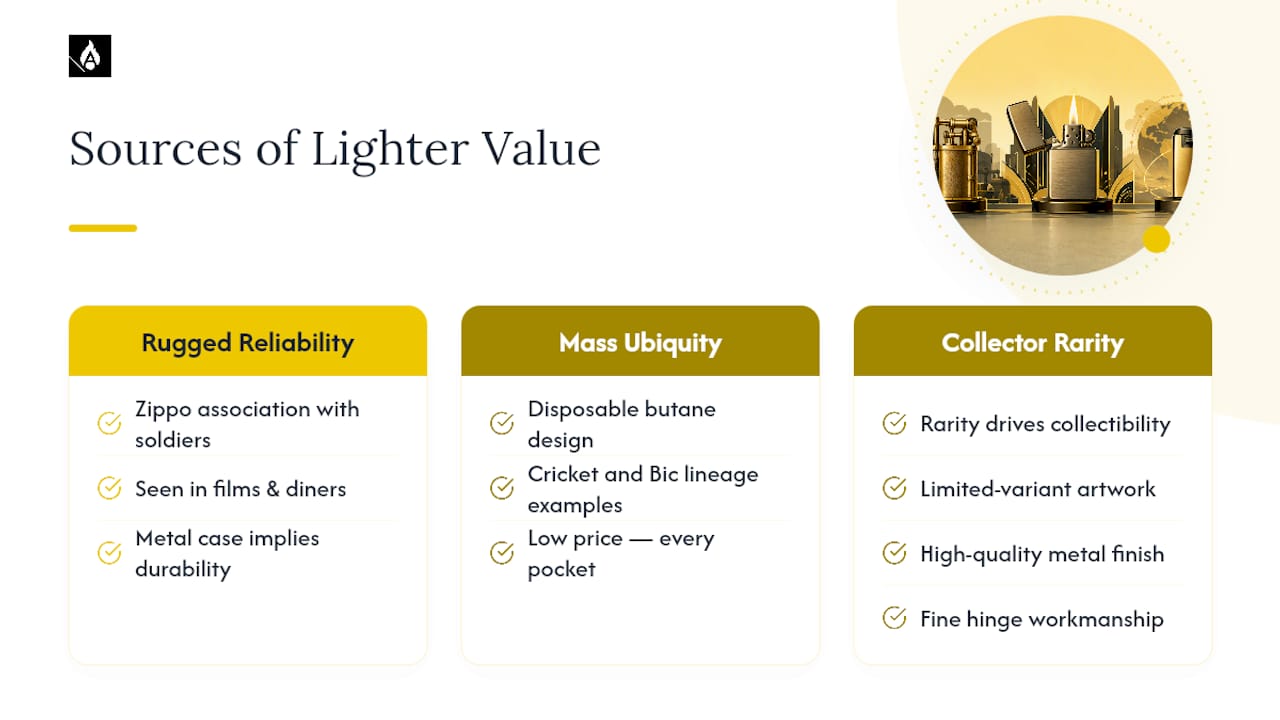
The Zippo’s association with soldiers, movie characters, and roadside diners turned a metal case into shorthand for rugged reliability, a reputation the brand still trades on decades later. Disposable butane lighters earned the opposite kind of fame: ubiquity. Cricket and Bic-lineage disposables put a flame in every pocket at a price nobody had to think about. Collectors chase a third kind of value entirely, rarity, limited variant artwork, and the quality of the metal and hinge work that separates a genuine piece from a mass-produced copy.
How Allurecart Interprets a Century of Lighter Design
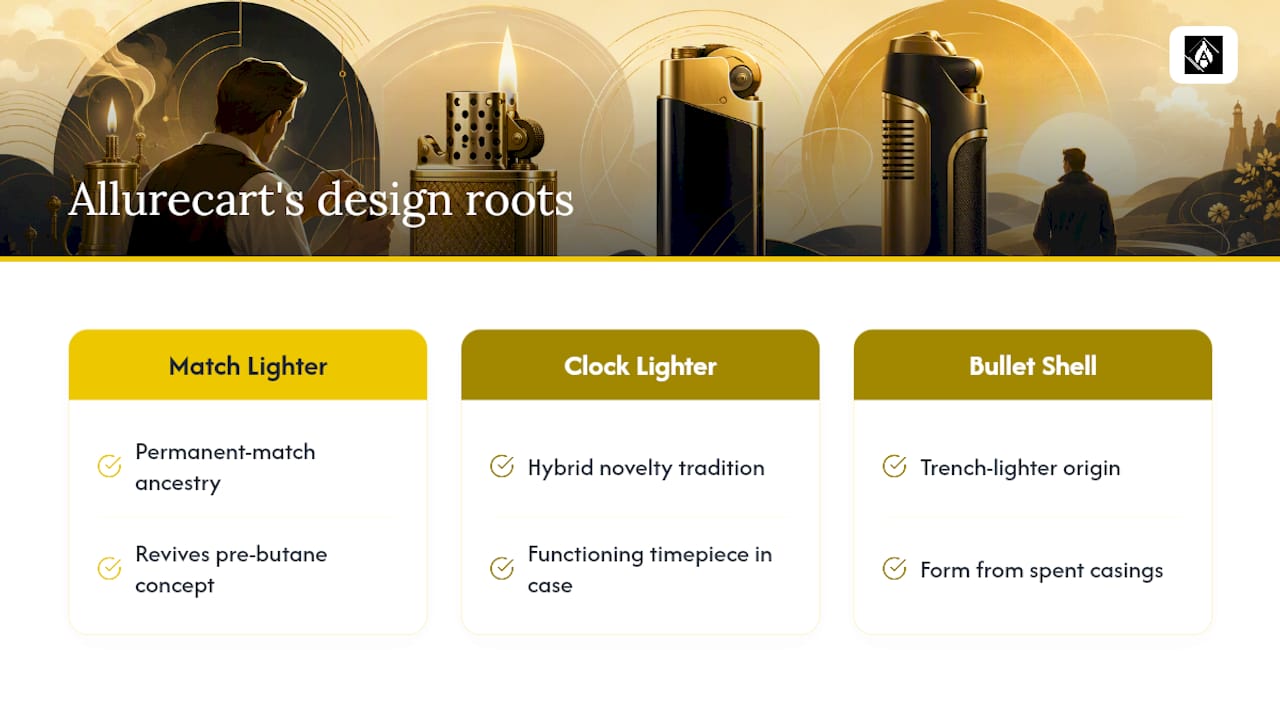
Every Allurecart piece is chosen with that century of design history in mind rather than treated as a blank product template. The Match Lighter revives the permanent-match concept that predates butane entirely. The Clock Lighter folds a functioning timepiece into a wind-resistant case, a direct descendant of the hybrid novelty tradition. The Bullet Shell Lighter draws its form straight from the trench-lighter era, when spent casings became the raw material of necessity. Allurecart curates for buyers who want a design story attached to their flame, not just a mechanism.
What Does This Design History Tell Us About What We Actually Value?
Function forced most of the big leaps in this history, ferrocerium, butane valves, windproof chimneys, but ornament decided which designs survived in cultural memory. Nobody reveres Döbereiner’s lamp as an object; they revere Zippo’s case, and that difference comes down to whether an invention also became something worth carrying and showing. When you’re evaluating a lighter today, weigh both halves of that equation. The engineering underneath still matters, but so does whether the object tells a story you want in your pocket.
— Allurecart
Own a Piece of That Design Lineage
Reading about a century of design pivots is one thing; holding a piece built on that lineage is another. Allurecart’s catalog turns each historical thread covered here, trench-era ingenuity, Deco-era metalwork, hybrid novelty craftsmanship, into a piece you can actually carry.
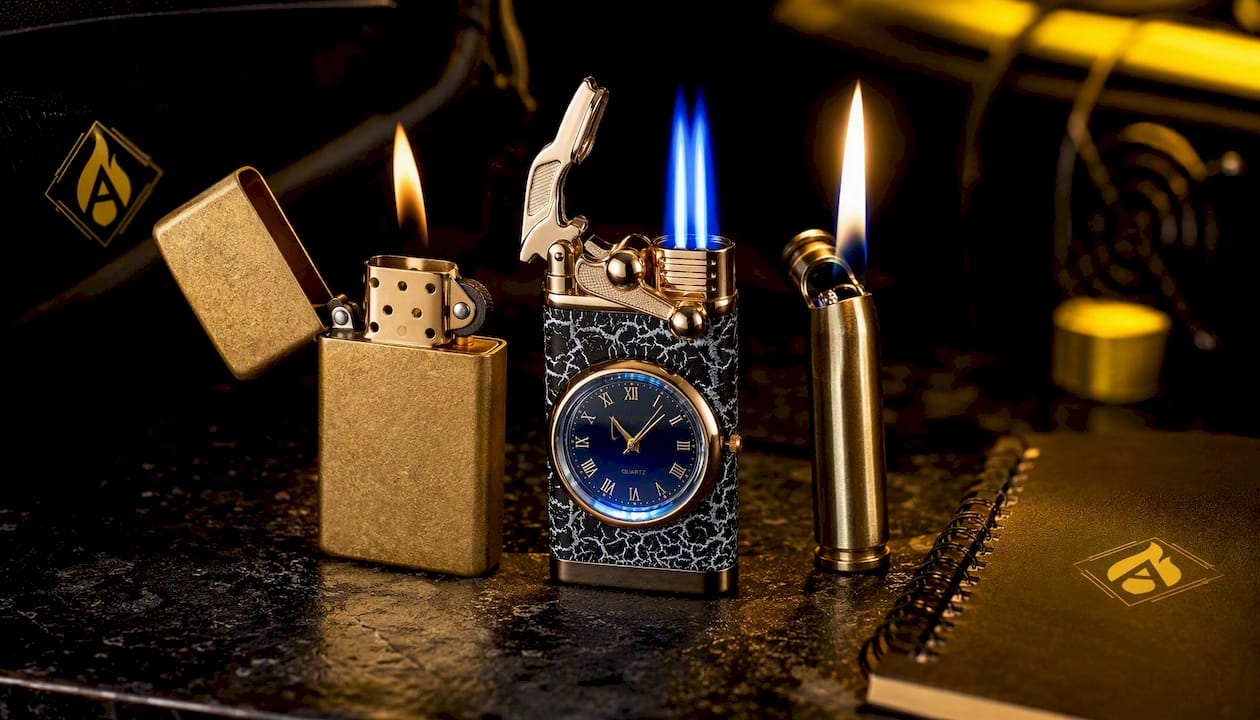
The Match Lighter reflects the permanent-flame ingenuity that predates modern fuel systems, while the Bullet Shell Lighter channels the trench-lighter tradition born out of wartime necessity, and the Clock Lighter merges function with the kind of mechanical showmanship Art Deco collectors prized. If you want a case built for daily wind resistance rather than novelty alone, the windproof jet torch design applies that same trench-era logic to a modern torch flame. Every order over $70 ships free worldwide, and each piece is selected for genuine spark reliability rather than looks alone. Browse the full Allurecart collection and pick the design era that speaks to you.
Sources
- Döbereiner’s Lamp — University of Bristol (project page)
- Carl Auer von Welsbach and ferrocerium (article/PDF)
- Lighter — Wikipedia
- A Brief History of Flame: The Story of the Everyday Lighter — Sharrow Mills
- History of Lighters — Toledo-Bend