

Gun-shaped novelty lighters are legal to own in most U.S. states, but selling or distributing them is banned in several jurisdictions, including Illinois, New York, and Oregon. Federal rules add another layer: the Consumer Product Safety Commission requires child-resistant testing for lighters sold commercially, and both the TSA and FAA bar these devices from air travel. The short version: possession is rarely the problem. Sale, shipping, and airports are where the real risk lives.
TL;DR:
- Selling or distributing gun-shaped novelty lighters is banned in states like Illinois, New York, and Oregon, with fines up to $10,000 for manufacturers and importers.
- Federal regulations require child-resistant testing and product documentation, even for shapes that trigger “novelty” classification regardless of function.
- TSA and FAA ban operable gun-shaped lighters on airplanes, and security officers can confiscate any shaped like a firearm, regardless of legality.
- Nearly all states exempt personal possession of already owned novelty lighters, but public carrying or display near sensitive sites can still trigger enforcement actions.
- Local city and county ordinances may impose restrictions beyond state laws, especially around schools, courthouses, or municipal buildings.
Table of Contents
- State Bans and How “Novelty Lighter” Gets Defined
- Federal Safety Standards: What CPSC Rule 16 CFR Part 1210 Actually Requires
- Flying With a Gun-Shaped Lighter: TSA and FAA Rules
- Fines, Seizures, and Who Faces the Real Exposure
- Possession vs. Sale: What This Actually Means if You Already Own One
- What Manufacturers, Importers, and Retailers Need on File
- A Quick Checklist Before You Buy or Ship
- Do City Ordinances Add Another Layer?
- Gun-Shaped Lighters vs. Other Novelty Designs: Why the Shape Matters
- When a Novelty Lighter Gets Mistaken for a Real Weapon
- Why We Think Compliance Should Come Before Design
- Explore Allurecart’s Collectible Gun-Themed Lighters
- Sources
State Bans and How “Novelty Lighter” Gets Defined
State fire marshals didn’t dream up novelty lighter bans to annoy collectors. They wrote them because kids kept getting hurt by lighters shaped like toys, animals, or guns, mistaking them for playthings. Most statutes define a “novelty lighter” by appearance and appeal rather than by function. If it flashes, plays music, or resembles a cartoon character, a vehicle, or a firearm, it typically qualifies, regardless of what the seller calls it.
Several states have codified outright bans on retail sale:
- Illinois classifies unauthorized sale as a petty offense, with fines running up to $500 per offense, per day the violation continues.
- New York authorizes civil penalties up to $10,000 for manufacturers and importers, with lower tiers for wholesalers and retailers.
- Oregon bans sale or distribution outright under its own statute, with similar language defining prohibited shapes and effects.
- New Jersey, Nevada, and Tennessee carry comparable prohibitions, each targeting the supply chain rather than the end user.
Most of these laws exempt pre-1980 collectible lighters and standard printed disposable lighters that merely carry a design on the wrapper rather than a three-dimensional novelty shape.
Federal Safety Standards: What CPSC Rule 16 CFR Part 1210 Actually Requires
Before any state weighs in, federal law already governs how lighters get made and sold. The CPSC’s 16 CFR Part 1210 standard requires child-resistant mechanisms on lighters sold in commerce, tested against a panel of young children.
Statistic Callout: The design standard requires that most tested young children be unable to successfully operate the lighter before certification.
Manufacturers and importers face real obligations under this rule:
- Qualification testing before a product line ever ships
- Ongoing production testing to confirm consistency across batches
- Written product specifications and recordkeeping the CPSC can request during an investigation
Here’s the part sellers often miss: a lighter’s shape alone, gun, grenade, or otherwise, can trigger “novelty” classification under federal rules even before any state law applies.
Flying With a Gun-Shaped Lighter: TSA and FAA Rules
Air travel is where gun lighter laws get strictest, fastest. The TSA lists gun-shaped lighters as items not permitted through security checkpoints, in carry-on bags or checked luggage. The final call belongs to the officer at the checkpoint, and that officer has no obligation to give you the benefit of the doubt on a device shaped like a firearm.
Three practical rules to know before you pack:
- Skip the checkpoint entirely. Don’t bring an operable gun-shaped lighter to the airport in any form of luggage.
- Know the torch-lighter limit. FAA hazmat guidance bars torch and jet-flame lighters from aircraft entirely, while standard butane and Zippo-style lighters face separate quantity limits.
- Watch battery-powered models. Lithium-battery lighters carry their own watt-hour restrictions and packing rules under FAA guidance.
If you want to travel with a collectible, ship it as cargo under hazmat rules or carry a version rendered permanently non-operable.
Fines, Seizures, and Who Faces the Real Exposure
Enforcement almost never targets the person who owns a novelty lighter. It targets whoever put it on a shelf.
- Manufacturers and importers face the steepest civil exposure, up to $10,000 per violation in New York’s tiered schedule.
- Wholesalers and retailers face lower but still meaningful penalty tiers under the same statutes.
- Illinois enforces a daily fine structure, so penalties can accumulate for ongoing violations.
- Fire marshals and local police typically hold seizure authority over inventory, pulling stock directly from shelves once a violation is confirmed.
- Some jurisdictions layer misdemeanor charges on top of civil fines for repeat or willful violations.
A single complaint can trigger an inspection. Retailers who think a quiet corner shelf keeps them safe are wrong.
Possession vs. Sale: What This Actually Means if You Already Own One
Here’s the distinction that resolves most of the anxiety around this topic: nearly every state ban targets commercial sale and distribution, not private ownership. If you already have a gun-shaped novelty lighter sitting in a drawer, you are almost certainly not breaking any law by keeping it.
Carrying it in public is a different story, not because of the lighter statute, but because of how it looks to a police officer or security guard in the moment.
- Keep operable novelty lighters as display pieces at home rather than daily carry items.
- If you plan to travel with one, de-fuel it or otherwise render it non-operable first.
- Avoid bringing any gun-shaped lighter into a school zone, courthouse, or federal building, where separate weapon-look-alike rules may apply regardless of the device’s actual function.
Pro Tip: A lighter that can no longer hold fuel or produce a flame often falls outside the statutory definition of an “operable” novelty lighter, which is why serious collectors sometimes deactivate display pieces before showing them off in public.
What Manufacturers, Importers, and Retailers Need on File
Compliance for sellers isn’t complicated, but it does require a paper trail. Under 16 CFR Part 1210, manufacturers and importers must maintain qualification test results, production test logs, and written specifications ready for CPSC review at any time.
Beyond federal testing, sellers need distribution controls tuned to state law:
- Test and certify first. No product should ship without documented child-resistance testing on file.
- Geoblock banned states. Illinois, New York, and Oregon addresses should never receive a shipment of an operable novelty design.
- Label accurately. Packaging should disclose the certification status rather than leaving it implied.
- Train staff. Store employees need to recognize which shapes trigger novelty classification, since hiding a product behind the counter doesn’t exempt a retailer from a sale-based ban.
- Keep records. Retain invoices and shipping logs that prove where inventory went, in case a fire marshal asks.
Smoke shops and tobacco accessory retailers face particularly close scrutiny here, and general tobacco-retail compliance practices around age verification and inventory tracking apply just as directly to novelty lighter stock.
A Quick Checklist Before You Buy or Ship
Before money changes hands, both sides of the transaction have a job to do.
For sellers: confirm CPSC test documentation exists for the specific product line, refuse orders shipping into banned states, and keep dated records of every sale and shipment.
For buyers: ask the seller directly whether the product is certified under 16 CFR Part 1210, confirm they won’t ship into your state if your state restricts the item, and consider a permanently non-operable collectible if you live somewhere with a strict ban. A quick email asking “can you provide your CPSC compliance documentation for this item” is enough to separate a serious seller from a risky one.
Do City Ordinances Add Another Layer?
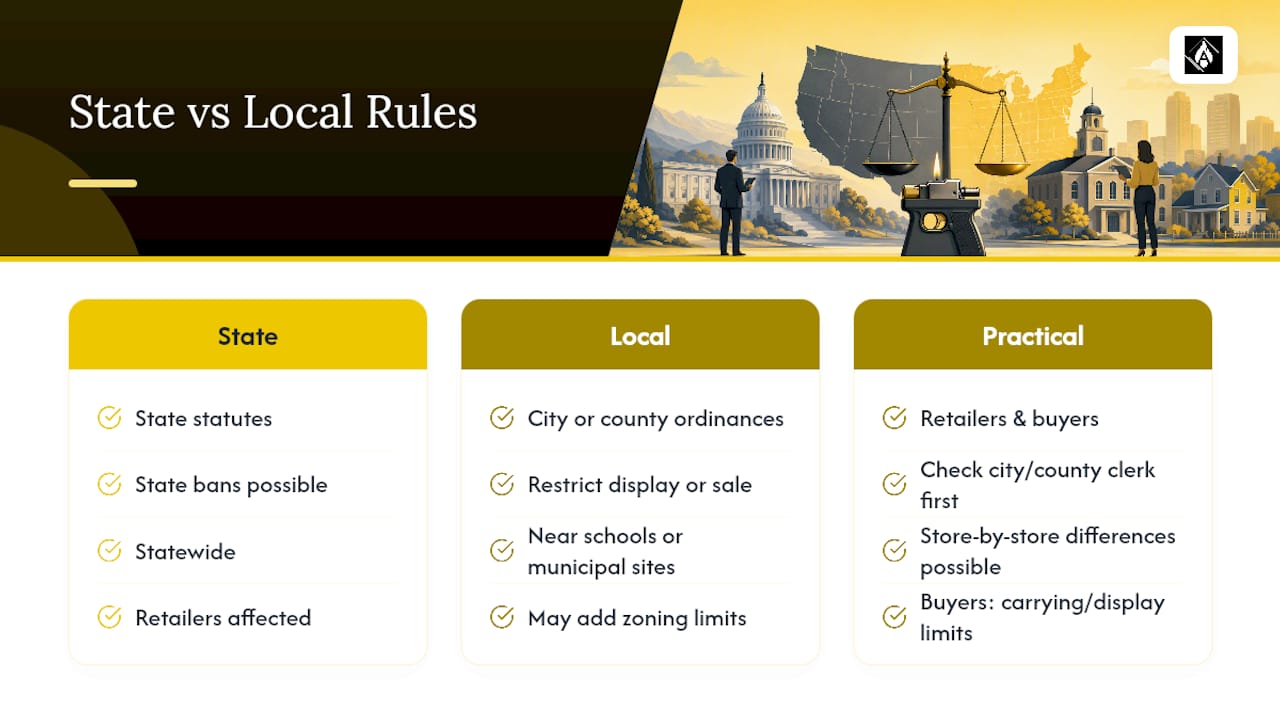
State law is not the last word. Cities and counties can, and sometimes do, layer their own restrictions on top of state statutes, and these local ordinances rarely make national news the way state bans do.
A city council worried about youth access to lighters near schools can pass a local ordinance restricting display or sale within a certain radius, even in a state with no statewide novelty lighter ban at all. Municipal fire codes sometimes fold novelty lighter restrictions into broader fireworks or hazardous-materials ordinances, which means a search for state law alone can miss a rule that applies right where you live or sell.
This matters most for retailers operating in multiple cities within the same state. A shop with locations in two different municipalities can find one store fully compliant and the other in violation, purely because of a local ordinance the statewide fire marshal’s office never mentions. Local zoning rules can also restrict where a tobacco or novelty-item retailer can operate at all, independent of what it sells.
The practical move is straightforward: check with your city or county clerk’s office, not just your state fire marshal, before opening retail distribution in a new area. For individual buyers, local ordinances almost never touch simple possession, but they can affect where you’re allowed to carry or display an item publicly, particularly near schools, courthouses, or municipal buildings where weapon-look-alike rules sometimes get folded into unrelated codes.
Gun-Shaped Lighters vs. Other Novelty Designs: Why the Shape Matters
Not all novelty lighters draw equal scrutiny, and the gun shape carries a distinct kind of legal and practical risk that a cartoon character or a rocket ship simply doesn’t.
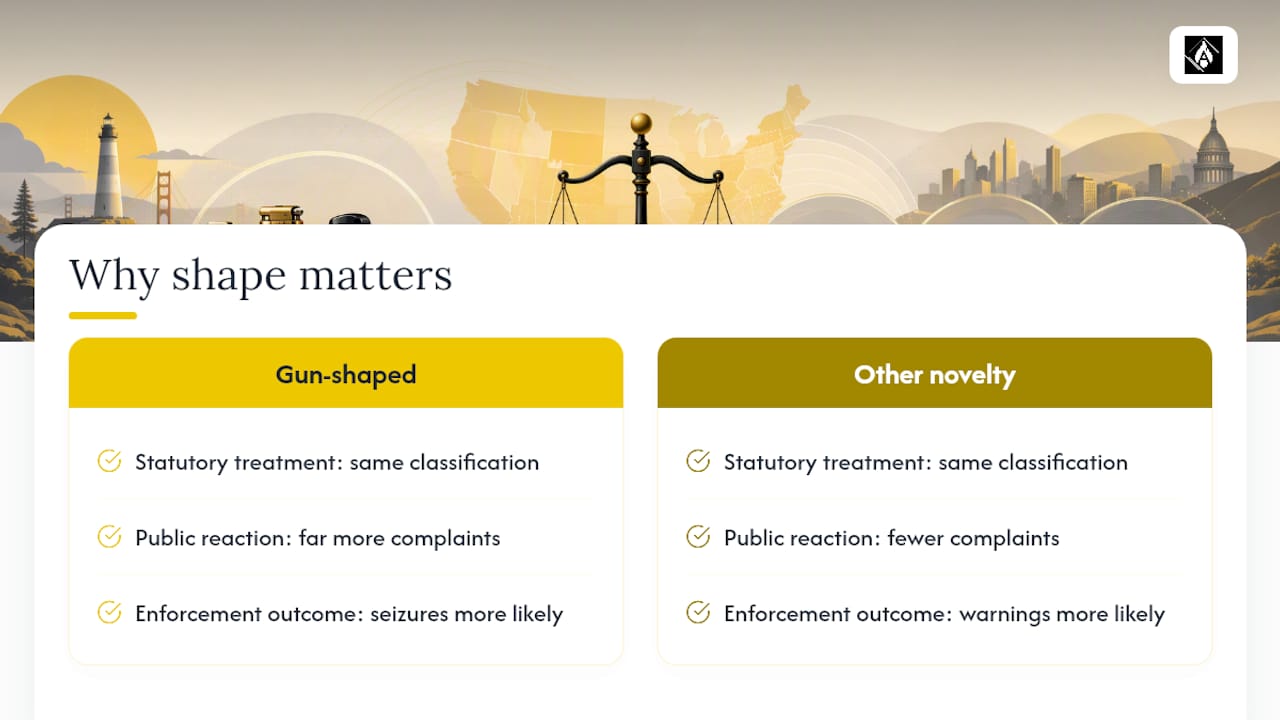
Statutory language in most banned states treats all novelty shapes the same on paper, guns, toys, vehicles, and animals all trigger the same “novelty lighter” classification if they’re designed to appeal to children. But enforcement in practice skews toward whichever shapes generate complaints, and gun-shaped items generate far more of them than a lighter shaped like a cartoon dinosaur.
The mismatch shows up most sharply outside the lighter statute entirely. A grenade-shaped or extinguisher-shaped novelty lighter might raise eyebrows, but it won’t trigger the same reflexive concern from a police officer, TSA agent, or school administrator that a realistic gun shape does. That’s not a difference written into any novelty lighter statute. It’s a difference in how people react to the silhouette of a firearm versus the silhouette of almost anything else, and it’s the reason gun-shaped designs face tighter real-world handling even in states where the underlying law treats every novelty shape identically.
Retailers selling multiple novelty designs sometimes discover this the hard way: a grenade or fire-extinguisher lighter draws a warning, while a nearly identical gun-shaped item in the same display case draws a seizure. The statute didn’t distinguish. The enforcement officer did.
When a Novelty Lighter Gets Mistaken for a Real Weapon
The scenario that worries collectors most isn’t a fine. It’s the moment a realistic gun-shaped lighter gets pulled out in front of someone who has no time to ask questions.
Law enforcement and security personnel are trained to treat any object shaped like a firearm as a potential threat until proven otherwise, and that training doesn’t pause to consider whether the object in question is a novelty item purchased legally at a collector’s shop. A lighter pulled from a pocket at the wrong moment, in the wrong lighting, in front of the wrong person, can escalate a routine interaction into something far more serious, regardless of what the underlying statute says about possession being legal.
This risk sits entirely outside the novelty lighter statutes discussed elsewhere in this piece. No fire marshal fines you for a mistaken-identity encounter. But the practical consequences, a detained encounter, a confiscated item, a report filed against your name, can outlast any statutory penalty by a wide margin. Airports carry the same risk in a different form: a TSA officer doesn’t need to determine whether your lighter is a novelty item and functions correctly. The shape alone is enough grounds for confiscation under current guidance.
The takeaway for owners is simple and worth repeating: display pieces belong at home, not in a pocket, a glove compartment, or a carry-on bag. The legal right to own a collectible doesn’t protect you from how a stranger with a badge reacts to seeing one in the wild.
Why We Think Compliance Should Come Before Design
We build lighters meant to be admired first, functional second, but never at the expense of the law. We encourage every collector to verify their own state and local rules before adding a gun-shaped design to their collection. Craftsmanship means nothing if it lands you in legal trouble.
— Allurecart
Explore Allurecart’s Collectible Gun-Themed Lighters
If you’ve read this far, you already know that owning a striking, gun-shaped lighter is legal in most of the country, as long as you understand where the lines actually sit. This fits the niche of designing collectible pieces meant for display and personal use, not mass retail distribution into restricted states, which is the exact activity most novelty lighter bans target.
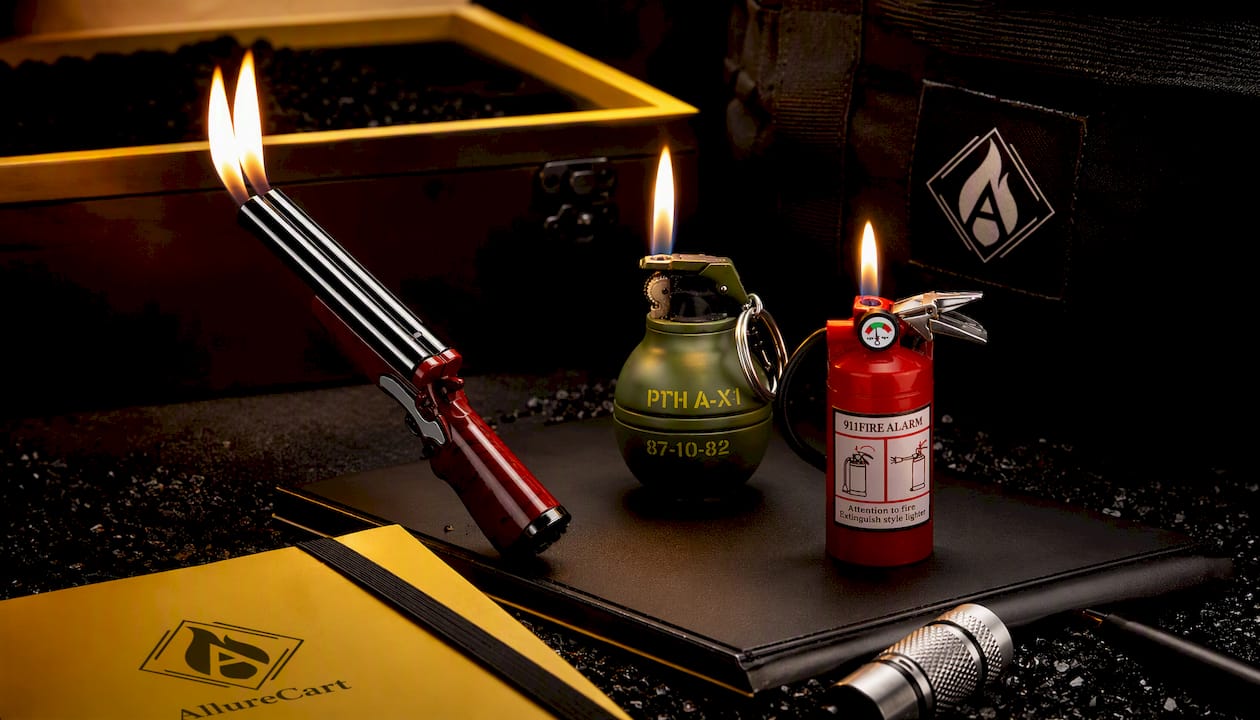
Our catalog features the Shotgun Lighter for collectors drawn to realistic firearm silhouettes, the Grenade Lighter for a different angle on military-inspired design, and the Extinguisher Lighter for something equally striking but far less likely to raise questions at a checkpoint. Each product page lists specifications, and we provide compliance documentation on request for buyers who want to confirm testing before they order. Browse the full Allurecart collection and check the details on a design that fits your collection, then reach out through the product page if you need paperwork before you buy.
Sources
- 16 CFR Part 1210 — Safety Standard for Cigarette Lighters (CPSC)
- Lighters (Gun) | Transportation Security Administration
- PackSafe - Lighters | Federal Aviation Administration
- Novelty Lighters — Illinois State Fire Marshal
- N.Y. General Business Law § 391-s — Sale and distribution of novelty lighters prohibited
This article is general information, not a substitute for advice from a qualified lawyer. Consult a qualified legal professional about your own circumstances before acting on anything here.